Approach
I don't begin with the tool. I begin with the human.
Tools change every few months. People don't change that fast. So before I teach anyone a new way to work, I want to understand how they already work, what pressures they're under, and what they're capable of.
This page explains the thinking behind that, and the methods I use to put it into practice.
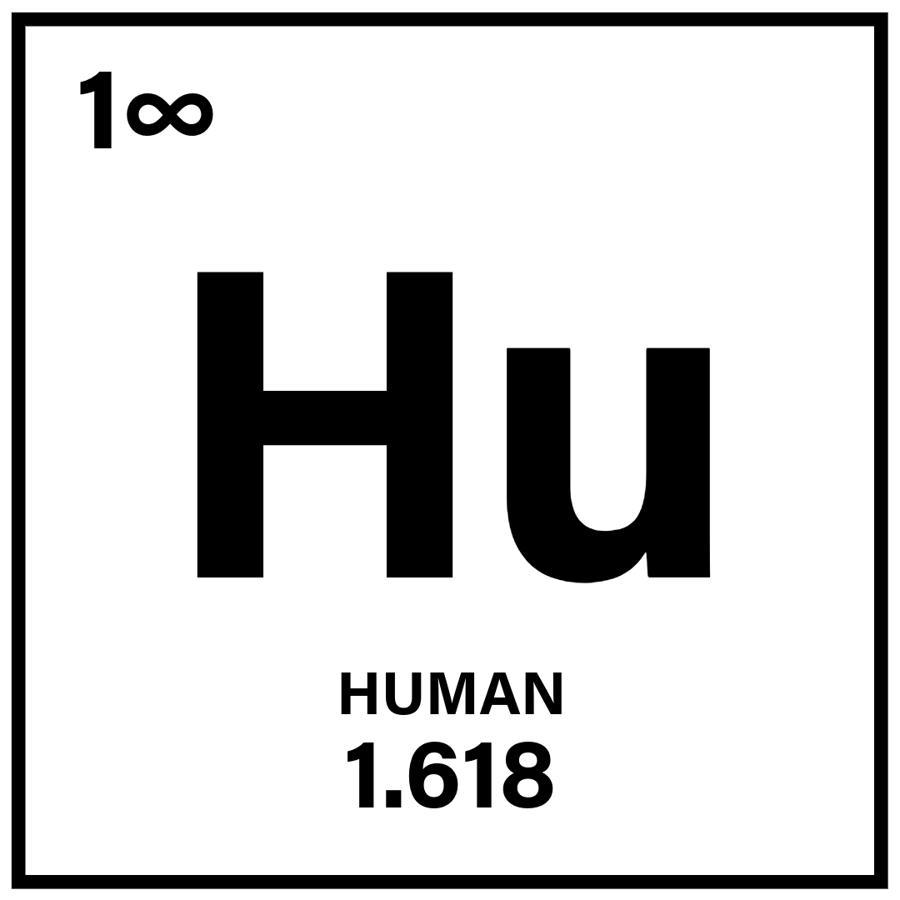
- READING THE MARK
- HuThe human, as an essential creative element.
- 1The power of one individual.
- ∞Unlimited creative potential.
- 1.618The Golden Ratio: balance, proportion and beauty. The meeting of logic and imagination that informs how I approach creativity and technology.
A familiar situation
The team gets the new tools. The training goes well. Three weeks later, under deadline, everyone is back to the old way of working.
It's tempting to blame the tool, or the training. Usually, it's neither. It's human, and once you can name what's happening, you can work with it instead of against it.
New tools and processes that aren't attached to current workflows rarely last. When they don't mesh, we revert quickly. We might see the coolest thing ever, but in practice, humans are more creatures of habit than arbiters of time-saving processes.
So instead of more training, the new practice gets built into a step the team already takes every day, and practiced there until it's what they do under pressure too.
The philosophy underneath everything
The [Hu]man Element
A map of the human responsibilities we must retain and the human tendencies we must account for, especially as technology amplifies both.
It shapes my teaching, speaking, AI LAB, branding and strategy work, and it reaches well beyond AI: identity, agency, judgment, motivation, adaptation, resistance, communication and purpose. AI just makes these dynamics easier to see, because it amplifies whatever intent, habits, strengths and dysfunction are already there.
16 Human FORCES
The diagnostic layer: the conditions and pressures that help explain why behavior happens.
You recognize a Force.
16 Human RULES
The operational layer: practical mechanics and levers that guide action, communication, learning and recovery.
You use a Rule.
The two tiers developed independently. They aren't matched pairs: one situation may involve several Forces and call for several Rules.
16 Forces · four Structural Cores
- 01Identity Anchors
- 02Belonging Bias
- 03Meaning-Making
- 04Mortality Awareness
- 05Complexity Threshold
- 06Change Tolerance
- 07Permission Structures
- 08Reconciliation Cost
- 09Default Behavior
- 10Momentum Loops
- 11Resistance Reflexes
- 12Debt Accumulation
- 13Conflict Avoidance
- 14Motivational Currency
- 15Shame Spirals
- 16Moral Injury
16 Rules · four sets of mechanics
- 01The Container Principle
- 02The Habit Hook
- 03The Attention Reservoir
- 04The Neuro Loop
- 05Visual-Verbal Divide
- 06The Mirror Gap
- 07The Bite-Size Brain
- 08The Reflection Loop
- 09The Intention Signal
- 10The Destination Vector
- 11Context Compass
- 12Protective Shift
- 13The Shadow Payoff
- 14The Return Ledger
- 15The Identity Load
- 16Fracture Threshold
The [Hu]man Element is © Brian Sykes. Its Forces and Rules are observations and working principles from my teaching practice, not a clinically validated assessment or diagnostic instrument.
What working together feels like
Understand. Discover. Return.
This is a simple way to describe the experience, not another framework to memorize.
The [Hu]man Element informs every stage· how I understand people, and how I design the workMethods you'll hear me name
Different tools for different jobs.
They aren't steps in a fixed sequence. Each one does a particular job, and I reach for whichever the work calls for.
Learning through unfamiliar contexts
First I understand how someone normally works. Then I give them a related challenge in an unfamiliar context, so they can explore without being constrained or distracted by familiar habits. They investigate, make real decisions, build new capabilities, and bring what they discover back into their actual work.
I call this UCDI: Unconventional Contextualization in Design Innovation.
Each step of how a learner works through the problem matters more than the generated output.
The seven stages of UCDI
- Unconventional Problem Solving. A real-world problem placed in an unconventional context, with challenges that defy traditional norms.
- Research & Exploration. AI-assisted research into the unfamiliar context, to deepen understanding and generate novel ideas.
- Innovative Conceptualization. Imaginative thinking toward solutions that are original and right for the context.
- AI Driven Creativity. Text-to-image and other AI tools for initial visual creation and ideation.
- Integration with Conventional Tools. Blending AI-generated solutions with established design tools and techniques.
- Context-Driven Design Application. Applying design principles so the work resonates with its specific setting.
- Reflective & Analytical Presentation. Documenting and presenting each step. Explaining what you did reinforces it.
AMP and RAMP
AMP extends strengths you already possess. RAMP helps you develop into new territory.
Both can happen in the same project. Neither one means AI removes the need to practice, or to use your own judgment.
The Hourglass: Refine, Elevate, Humanize
“AI can draft, but you decide and refine.”
Edit AI like a human, not a machine.
- HallucinationsAnything factually incorrect or wildly off-topic.
- FillerRepetitive, verbose or unnecessary language.
- Weak phrasesReplace generic, bland wording with sharp, evocative language.
- Stylistic quirksYour unique signature.
- Rhythm & toneThe musicality and emotion of your creative output.
- Perspective & opinionYour distinct point of view that AI cannot replicate.
- Personal storiesThe anecdotes, experiences and empathy that only a human can bring.
Run anything AI helped create through these before it sees the light of day. Take them with you.
- VoiceDoes this sound like us?
- ValuesDoes this feel like us?
- AudienceDoes this serve who we're trying to reach?
In practice · AI LAB LEVELS
Design a smartwatch for 1830.
In LEVELS, nobody could fall back on a familiar solution. There's no template for an 1830 smartwatch ad. Participants had to research the period, make deliberate decisions, and combine AI with traditional design tools to get there.
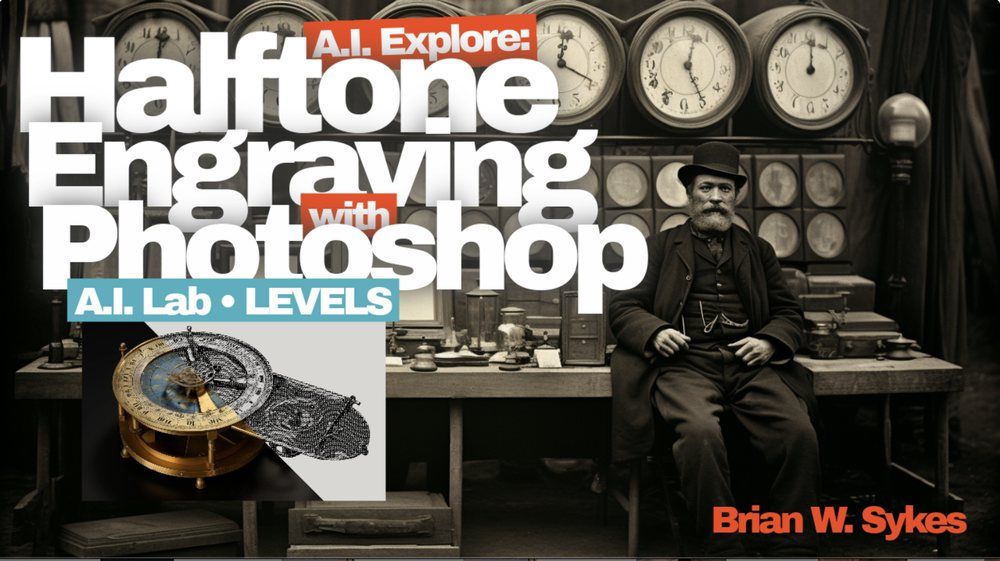
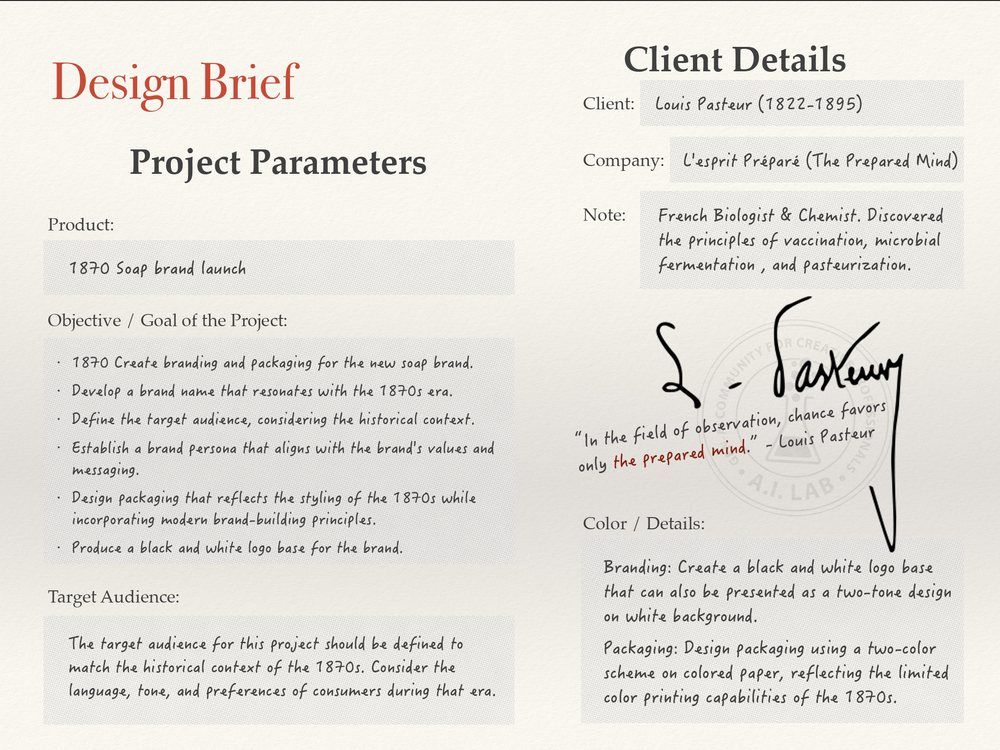
Research, advertising history, creative direction, and moving between AI and conventional tools, all applied to deliberate decisions they could carry back into contemporary work.
A tool from the lab
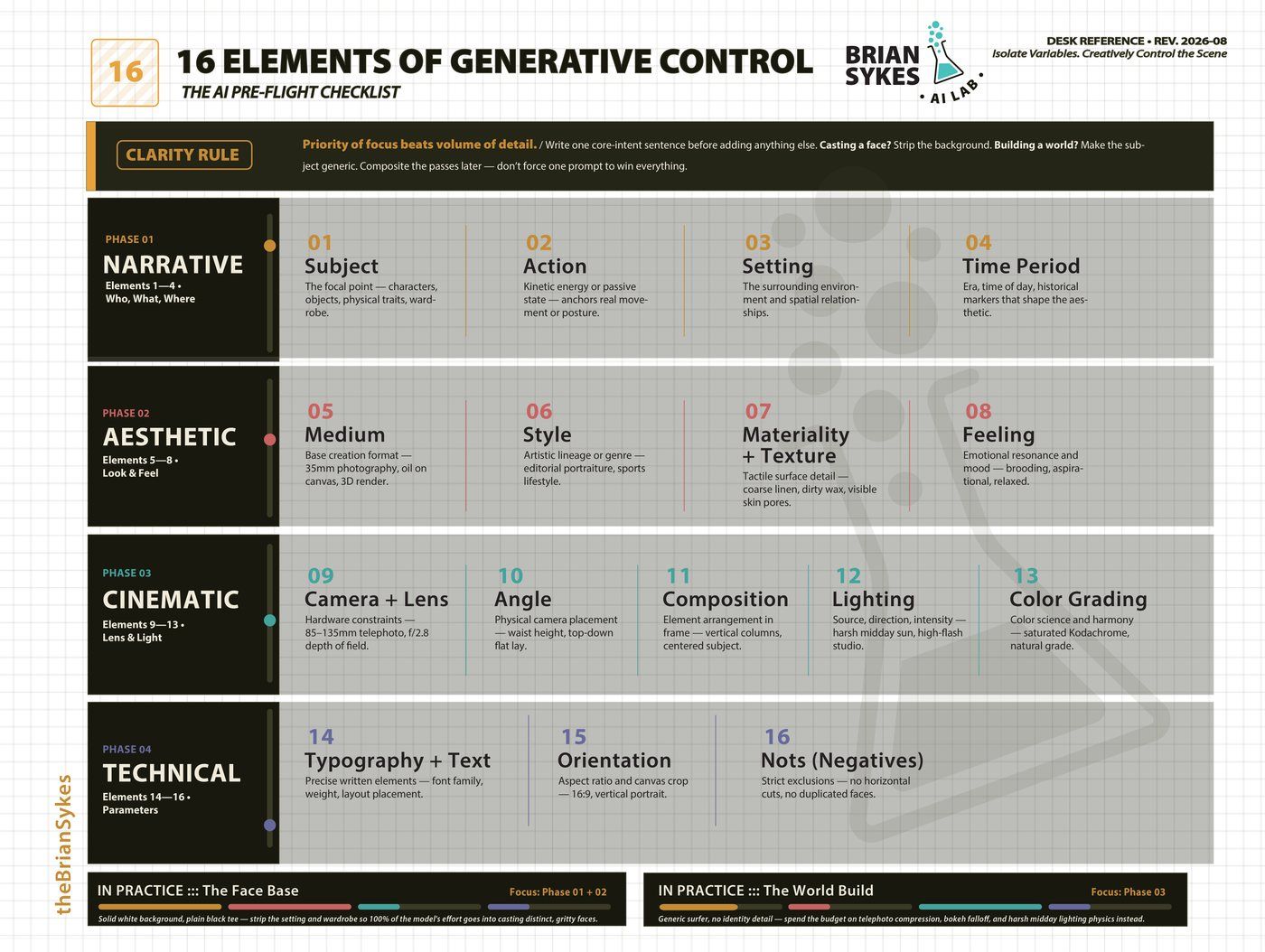
16 Elements of Generative Control
An AI pre-flight checklist: sixteen elements, from Subject and Setting to Lighting and Negatives, grouped into Narrative, Aesthetic, Cinematic and Technical phases.
Go deeper
Put the approach to work.
© 2026 Brian Sykes · theBrianSykes.com